architecture portfolio
VICTOR KWOK SEONG TAN

back
YEAR 5 DESIGN STUDIO

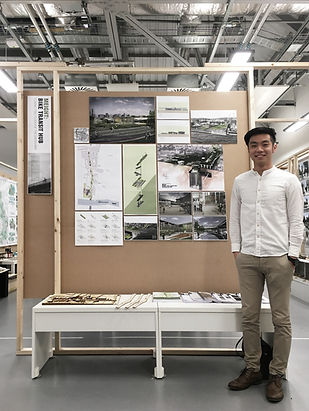
MEight: Bike Transit Hub
abstract
Aiming to revitalise and reunite Glasgow into one green, healthy and vehicle-free city, MEight (pronounced ‘Mate’) sets out to encourage Glaswegians to cycle more by repurposing the M8 motorway which currently pierces through the city. Glasgow isn’t and hasn’t been known as a cycle-friendly city and there are many contributing factors to that statement; challenging terrain, absence of bike routes and poor bike facilities just to name a few.
Therefore with the MEight repurposing and revitalising project, it bridges the gap by providing a more seamless cycling experience, from transitioning commutes to getting around the city altogether.
Reclaiming the M8 brings about many advantages to the community, first and foremost is the removal of the virtual wall separating the City Centre and the West End of Glasgow, hence reuniting the once divided city. Besides that, important landmarks along the motorway such as the Mitchell Library gain new means of accessibility and functionality. Lastly, it also diminishes the amount of vehicle from coming into the City Centre, thus achieving lesser traffic congestion and a safer cycling experience.
To successfully stitch all these qualities together, an MEight Bike Transit Hub is introduced just along River Clyde and by the Kingston Bridge. Cars that used to dominate the M8 are now moved underground in a tunnel that runs parallel to the original M8. The tunnel features state-of-art technologies such as NOx filtration and kinetic energy harvesting. The tunnel also connects drivers directly into an automated carpark in which is underneath the MEight Bike Transit Hub. Drivers can then seamlessly transition into using a bike and utilise the wide connectivity and facilities provided by the MEight Bike Transit Hub.
The MEight is believed to be the answer to a greener, healthier and more connected Glasgow.
publication


renders
introducing the MEight: Bike Transit Hub
The MEight Bike Transit Hub, also known as BTH, is Glasgow’s first major Cycle Hire centre which incorporates the true concept of zero emission. Serving as the bridge (figuratively) between two ambitious ideas which are the Underground M8 (phase 1) and the MEight (phase 2), the BTH features a core which allows drivers to surface from the massive automated park and ride onto the MEight effortlessly.
MEight Bike Transit Hub mainly operates as a transition terminal ranging from:
-
car-to-bike
-
foot-to-bike
-
train-to-bike and vice versa
Aiming to initiate an emission-free transportation system that could connect Glaswegians across the city centre, the BTH must provide commuters a seamless transition and hassle-free experience. Cycling convenience is key in designing the BTH.
Understanding that investment and commitment in a daily commute (bicycle, scooter etc) may not be ideal for each individual, the BTH prominently features a Bike Rental service which is attached to the core of the building. This is also ideal for tourists who wish to ride around the city for just a day or two.
Out of sheer convenience, commuters may also choose to store their own personal bicycle with BTH and pick it up whenever they are in town. This service is particularly exemplary for train-to-bike commuters.
As cyclists, be it professional or casual, bicycles should be frequently checked and maintained. A Bike Workshop is featured on the west-side of the BTH. Cyclists can consult bike mechanics and gain professional advice on maintenance. Tools and space can be rented to work on your personal bike as well. This allows the cycling community to better bond and socialise. Ample outdoor space on the workshop front is available for bike testing and weekend family activities as well.
The Workshop is intentionally placed away from the Bike Rental area as the Bike Rental centre is believe to accommodate many fast-moving users, in and out in a matter of minutes whereas the Workshop will accommodate users who are there to stay, spending a day working away on their bicycles, hence both areas should not be too close together.
Having cyclist frequently pass through the building, the location naturally becomes a business strategic area. Other than having retails and food & beverage on the ground floor, which also act as a buffer zone between the Bike Rental & Workshop, the Bike Transit Hub features a Ride-thru Market which is truly one of its kind on the intermediate floor. Cyclists need no get off their bikes to shop on this area; cyclists simply take a ramp up onto the intermediate floor from one of two ramps that is present by the workshop and in the Bike Rental Shop itself. The ride-thru market is also accessible from an existing bicycle path/bridge from across the street of Stobcross. Lastly, cyclists can conveniently cycle onto the MEight from the intermediate level as well, in which strengthens the ties between the MEight and the surface level along the Clyde.
Each facility present on the MEight Bike Transit Hub is designed solely with the convenience of a cyclist in mind, as this is believed to be the first step towards a bigger, greener picture. With such seamless transition, it is believed to be able to switch up the status quo and skew away one’s reliance on a car. Connecting Glasgow the green way.
 |  |  |  |  |  |  |
|---|
conclusion
Glasgow is believed to be struggling with overcoming her air quality crisis over the years. Having failed The World Health Organization (WHO) test on fine sooty particles linked to heart disease and premature death, 16 micrograms of the particles per cubic metre of air (exceeding the 10 micrograms safe limit), Glasgow must address her air quality issue as soon as possible.
While vehicles are found to be the primary contributor to toxic gas emissions, methods in addressing air pollution became clear. Reducing cars from entering the city and encouraging Glaswegians to cycle seem to be the perfect solution. Only problem is Glasgow has been taking action and been doing exactly that for the past few years, yet Glasgow’s air hasn’t seen significant improvement. What seems to be the issue?
With careful research and study, the MEight Bike Transit Hub (BTH) is believed to be the answer to this air pollution crisis.
Firstly, our attention should be drawn towards the M8 Motorway since it is where the bulk of vehicles and traffic congestion starts. By submerging the motorway, nasty emission can be captured and filtered. Careful tunnel design also help harvest renewable energy (kinetic energy) and prevent traffic build-up. A massive and advanced automated Park and Ride system that is directly attached with the Underground M8 eases the process of leaving one’s car out of the city centre.
A reclaimed stretch of the M8 Motorway now repurposed into a park. Similarly to NYC’s Highline and Copenhagen’s Superkilen, the repurposed M8, now dubbed MEight, will bring a new light to healthy lifestyle and greener connectivity.
Lastly, the MEight Bike Transit Hub, which sits nicely between the Underground M8 and the MEight, fills in the void and brings these ambitious ideas into fruition. Understanding that Glaswegians mainly rely on their cars due to convenience, there is reason to believe that by providing a seamless commuting transition, it will greatly encourage Glaswegians to switch up their status quo. The MEight Bike Transit Hub, other than being situated in strategic location, features facilities that truly allow for a hassle-free transit.
The MEight Bike Transit Hub goes hand-in-hand with the action plans of the Glasgow City Council and is sure to be favoured by the community. The BTH is strongly believed to effectively be the stepping stone towards a greener Glasgow by influencing a green lifestyle. The BTH stays true to its mission that is ‘Connecting Glasgow the Green Way’.